Wow. We’ve officially crossed a threshold.
Over the last weeks, I’ve been talking to customers and they’re all at the same point: they’re running multiple AI coding agents in the same codebase, in parallel.
They’re not asking “should we use agents?”
They’re asking:
- How do we run more of them?
- How do we manage worktrees?
- How do we prevent overlapping changes?
- How do we orchestrate cross-repo refactors?
- How do we schedule recurring autonomous tasks?
They’re not experimenting anymore.
They’re turbocharging their coding process.
And tools like Warp Oz or multi-agent systems from Anthropic are accelerating this shift fast.
This is not incremental.
This is a structural change in how software evolves.
The End of the Single-Agent Era
A year ago, an AI assistant helped you write code.
Today:
- 10 agents refactor in parallel
- 20 agents fix dependency chains
- 5 agents update documentation
- 3 agents rewrite test suites
- Another batch runs scheduled maintenance
All inside the same repositories.
In some teams, this is already normal.
Your laptop is no longer the constraint. Cloud agent orchestration removes that ceiling.
And when you remove the ceiling, the nature of the system changes.
Velocity Is No Longer the Bottleneck
For years, engineering focused on productivity:
- Faster CI
- Better tooling
- Code generation
- DevEx optimization
Now the bottleneck isn’t output.
It’s coordination.
It’s overlap.
It’s unintended consequences.
When fifty agents modify twelve repositories in parallel, changes stop being sequential.
They become:
- Bursty
- Distributed
- Asynchronous
- Harder to mentally model
And that’s where the real shift happens.
Automation Multiplies Entropy
Here’s the uncomfortable part.
Every automated change increases entropy.
One agent making a scoped fix? Manageable.
Dozens of agents:
- Refactoring shared abstractions
- Updating auth flows
- Changing validation logic
- Modifying API contracts
- Touching data-handling paths
That’s not just acceleration.
That’s system mutation.
And mutation compounds.
Hidden coupling increases. Implicit assumptions break. Architectural intent drifts.
Humans used to be the synchronization layer. Slow, yes — but cognitively aware.
Now the system evolves faster than any human can continuously reason about it.
The Blind Spot Nobody Is Addressing
The industry conversation is focused on orchestration:
“How do we run more agents?” “How do we scale them?” “How do we schedule them?”
Very few are asking:
Who understands the global consequences of parallel autonomous changes?
Today’s agents optimize locally.
They:
- Solve the ticket
- Refactor the file
- Upgrade the dependency
- Close the alert
But risk doesn’t emerge locally.
It emerges globally.
Across:
- Repositories
- Business workflows
- Data flows
- Compliance obligations
- Architectural boundaries
The next wave of incidents won’t come from AI writing a bad loop.
It will come from AI systems accelerating architectural drift beyond human comprehension.
From Code Generation to Continuous System Evolution
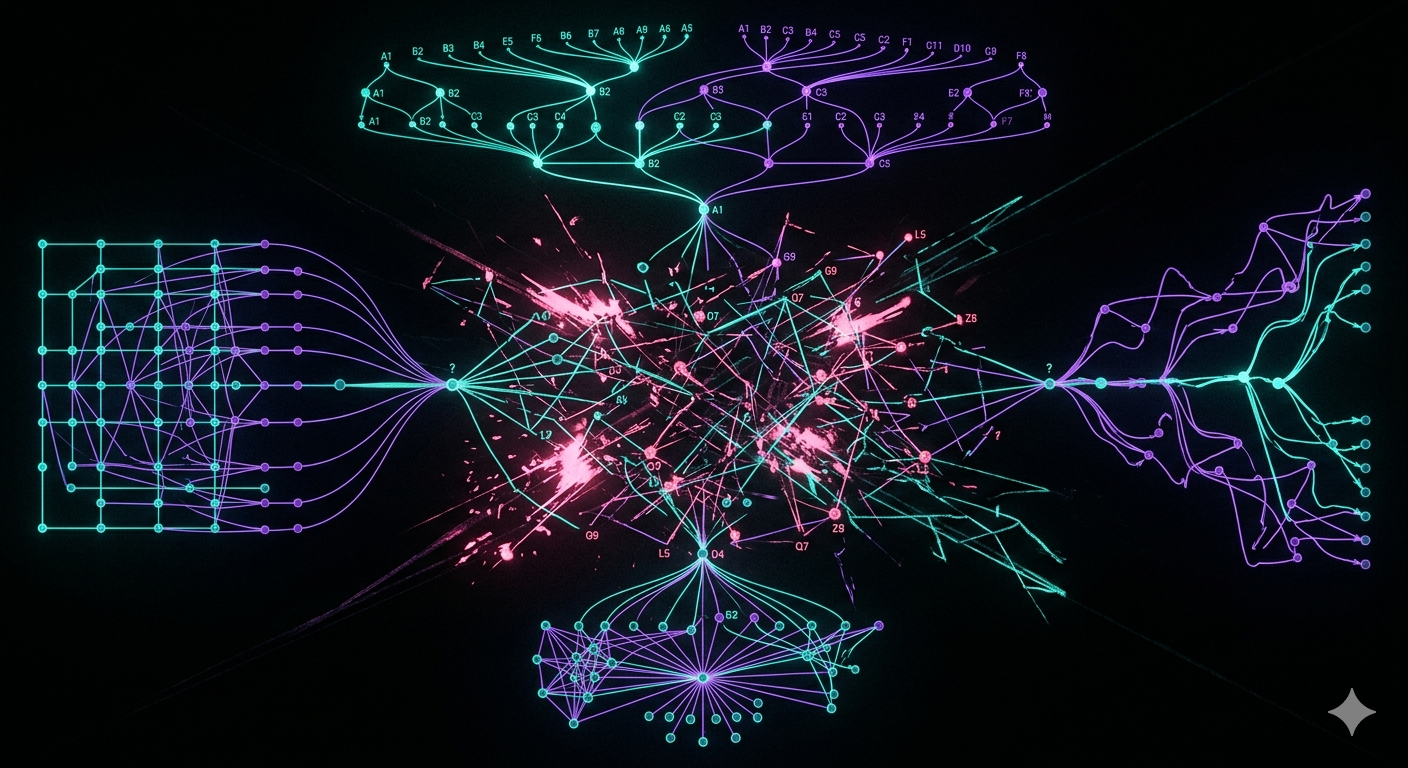
Multi-agent coding turns your codebase into a continuously evolving organism.
Changes are:
- Parallel
- Autonomous
- Recurring
- API-driven
- Cross-repo
This is no longer about writing code faster.
It’s about managing systemic complexity that grows faster than human reasoning capacity.
And our current validation models are outdated.
We still rely on:
- Static scanners
- PR reviews
- Snapshot audits
- Periodic compliance checks
Those models were built for human-paced change.
They are not designed for agent swarms.
The Real Constraint: Understanding
We now need a new layer:
- Cross-repo reasoning
- Architectural drift detection
- Design-to-code verification
- Business logic coherence validation
- Continuous compliance mapping
Not once per quarter.
Continuously.
Because the system is now in permanent motion.
The Governance Gap
Right now we have:
- Agent orchestration
- Agent logs
- Agent tracking
What we don’t have is:
- System-level reasoning
- Continuous architectural validation
- AI reviewing AI at scale
As agent infrastructure matures, a second layer becomes inevitable:
Agents that review agents. Agents that reason about the entire system. Agents that track exposure as code evolves autonomously.
Without that layer, velocity will outpace comprehension.
And when comprehension lags behind complexity, security debt compounds silently.
This Isn’t About 10x Engineering
It’s tempting to celebrate this as another productivity revolution.
But that’s superficial.
We’ve moved from:
Human-paced software evolution
to:
Autonomous, parallel, infrastructure-level system mutation
And in that world, the real competitive advantage isn’t speed.
It’s understanding.
Right now, speed is scaling faster than understanding.
That’s the gap that will define the next era of software engineering.
At Neuralsec, we’re building security that understands what code is doing, why it exists, and what’s at stake — so you can ship with confidence.